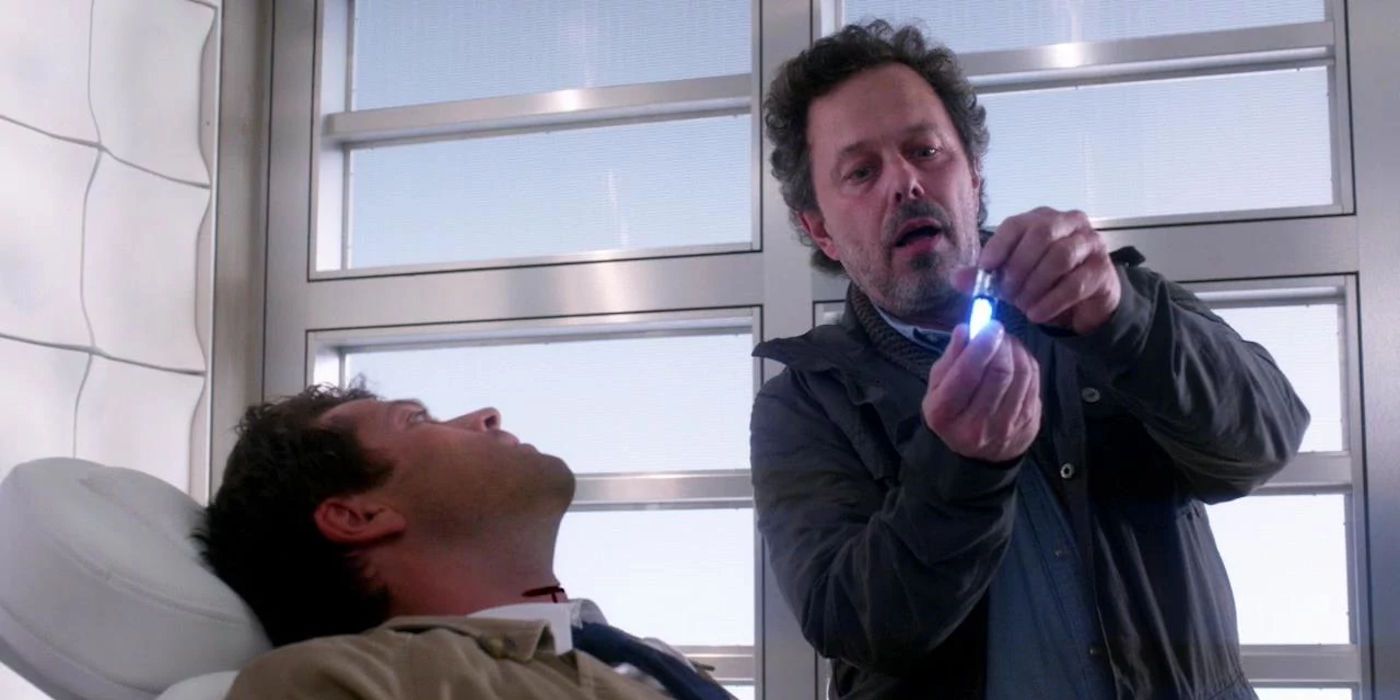
Curtis Armstrong. That’s the name. If you spent any time wandering through the later seasons of the CW’s marathon-run series Supernatural, you know exactly who he is, even if you spent half your screen time wanting to throw a remote at his head. He’s the guy who took the "Scribe of God" and turned him into a meta-fictional nightmare.
Who plays Metatron in Supernatural? It’s a question that usually leads people down a rabbit hole of 80s nostalgia because Armstrong isn't just some random character actor. He’s a legend of the "nerd" archetype. But in the world of the Winchesters, he wasn't the lovable underdog from Revenge of the Nerds. He was a vindictive, lonely, and dangerously literate bureaucrat who broke the world just because his feelings were hurt.
He first showed up in Season 8, specifically in the episode "The Reading of the Ritual." At first, he seemed like a hermit. A coward hiding in a hotel room in Colorado, surrounded by every book ever written. Most fans expected another wise, powerful entity like Castiel or a terrifying powerhouse like Raphael. Instead, we got a guy in a cardigan who just wanted to talk about stories.
The Man Behind the Quill: Curtis Armstrong’s Legacy
Before he was causing the Fall of the Angels, Curtis Armstrong was already a household name for a specific generation. You probably recognize him as Booger from the Revenge of the Nerds franchise. Or maybe as Herbert Viola in Moonlighting. He has this incredible ability to play characters that are simultaneously annoying and deeply pathetic, which is exactly why he was the perfect choice for Metatron.
He brings a specific kind of "punchable" energy to the role. Honestly, that’s a compliment to his acting. Metatron wasn't supposed to be a cool villain like Crowley or a terrifying one like Lucifer. He was supposed to be the guy you’ve worked with for twenty years who finally snaps because he never got a promotion. Armstrong leaned into the insecurity. He made Metatron’s obsession with being the "hero" of his own story feel desperate and real.
It’s easy to forget that Supernatural often struggled with its villains in the post-Swan Song era. After you’ve faced the actual literal Devil, where do you go? The showrunners decided to go smaller and pettier. They chose a scribe. And because of Armstrong’s comedic timing, he could pivot from being a bumbling comic relief character to a cold-blooded murderer in a heartbeat. Remember when he killed Dean? That wasn't a grand battle. It was a brutal, quiet moment that felt wrong specifically because of who was doing the stabbing.
👉 See also: Is Steven Weber Leaving Chicago Med? What Really Happened With Dean Archer
Why Metatron Was the Show’s Most Polarizing Character
People hated Metatron. Not "love to hate" like Crowley, but genuine, visceral frustration. A lot of that comes down to the writing, sure, but Armstrong’s delivery sold the narcissism. He represented the worst kind of fan—someone who thinks they know the story better than the characters living it.
He was the ultimate meta-commentary. By having a character who literally wrote the "Word of God," the show was able to poke fun at its own tropes. Metatron would talk about "character arcs" and "third-act twists" while he was torturing people. It was weird. It was polarizing. Some fans felt it broke the immersion too much. Others thought it was the smartest thing the show had done in years.
The dynamic between Armstrong and Misha Collins (Castiel) was particularly sharp. Castiel is all stoicism and misplaced duty; Metatron is all ego and flowery prose. Watching Armstrong manipulate Castiel throughout Season 9 was like watching a masterclass in gaslighting. He didn't use cosmic power to win; he used words. He used the fact that he was "just a scribe" to make everyone underestimate him until the angels were literally falling from the sky like shooting stars.
The Evolution of the Scribe
You have to look at how the character changed to appreciate the performance. In the beginning, he’s a shut-in. By the end of Season 9, he’s a god-complex-driven dictator. By Season 11, he’s a disgraced, homeless man looking for redemption.
That final arc is where Armstrong really showed his range. When Metatron confronts God (Chuck) in the bar during the episode "Don't Call Me Shurley," it’s one of the best scenes in the entire 15-season run. He isn't the villain anymore. He’s a disappointed son. He calls God out on His cynicism. He begs for the humanity he once despised.
✨ Don't miss: Is Heroes and Villains Legit? What You Need to Know Before Buying
It’s a weirdly heartbreaking moment for a character who spent two seasons being an absolute monster. It worked because Armstrong didn't play him as "reformed." He played him as tired. He was a man who had seen the end of the book and realized he didn't like the ending.
The Technical Side of Playing an Angel
Playing an angel in Supernatural usually meant wearing a trench coat or a suit and acting very stiff. Armstrong went the opposite way. He used his hands. He fidgeted. He ate pancakes. He made the celestial feel mundane, which was his whole motivation—he wanted to be the main character of a human story.
If you look back at his filmography, you see this pattern. Whether it’s Better Off Dead or New Girl, Armstrong excels at being the "extra" who demands the spotlight. In Supernatural, that trait became the character’s literal superpower. He stole the tablets, he stole the grace, and he nearly stole the show.
Many fans still debate if Metatron stayed too long. Some think the "angel civil war" plotline dragged. Maybe it did. But every time Armstrong was on screen, you were guaranteed a performance that felt distinct from the "tough guy" posturing that often filled the show. He was a different kind of threat—an intellectual one.
What Most People Get Wrong About Metatron
A common misconception is that Metatron was just a generic evil angel. He wasn't. He was actually the first "toxic fan" of the series. He loved God’s work (creation) so much that he couldn't stand it being "ruined" by humans or other angels.
🔗 Read more: Jack Blocker American Idol Journey: What Most People Get Wrong
When you rewatch his episodes, pay attention to how much he talks about literature. He mentions Kurt Vonnegut, The Great Gatsby, and even Tommy by the Who. He didn't want to rule the world because he liked power; he wanted to rule it because he thought he was a better writer than God.
- The Actor: Curtis Armstrong.
- The Debut: Season 8, Episode 21.
- The Kill Count: High. Including the (temporary) death of Dean Winchester.
- The Redemption: Sacrificed himself to help the Winchesters in Season 11.
His death was surprisingly quiet. No big explosion. Just a puff of light after he tried to hold off Amara (The Darkness). It was a fitting end for a character who started as a footnote in the margins of the Bible and ended up trying to write his own hero’s exit.
Actionable Takeaways for Supernatural Fans
If you're doing a rewatch or just catching up on the lore, here is how to actually appreciate the Metatron era without getting frustrated by the character's antics:
- Watch for the Meta-Layer: Look for the moments Metatron critiques the show's own writing. It’s the writers talking directly to the audience through Curtis Armstrong.
- Compare Season 8 to Season 11: The physical transformation Armstrong undergoes—from the pristine, smug scribe to the grimy, broken man in the trench coat—is a masterclass in subtle costume and acting shifts.
- Check out Curtis Armstrong’s Memoir: If you like his voice, he wrote a book called Revenge of the Nerd. It’s filled with stories about his time in Hollywood, and he speaks very fondly of his time on the Supernatural set, despite playing such a reviled character.
- Focus on the "Don't Call Me Shurley" Monologue: If you only watch one Metatron scene, make it his confrontation with Chuck in Season 11. It recontextualizes everything he did in the previous seasons.
Metatron remains one of the most complex figures in the series. He wasn't a demon, and he wasn't really a "good" angel. He was just a guy with too much power and a very large library. Curtis Armstrong took a character that could have been a one-dimensional villain and turned him into a tragic, annoying, and ultimately essential part of the Supernatural mythos.
To get the full picture of Armstrong’s impact, go back to Season 9, Episode 18, "Meta Fiction." It’s the episode where he literally breaks the fourth wall and talks to the audience. It summarizes everything he brought to the role: ego, brilliance, and a touch of madness. Whether you love him or hate him, the show wouldn't have been the same without the Scribe.
Next time you see a character in a show who seems a bit too obsessed with the "plot," you’ll know exactly whose footsteps they’re walking in. Armstrong set the template for the modern meta-villain, and he did it while wearing a really ugly sweater. That’s talent.
To dive deeper into the lore of the show's celestial beings, compare Metatron's arc with that of Gadreel or even the later versions of Lucifer. You'll find that while other villains wanted to destroy the world, Metatron was the only one who actually wanted to edit it. That distinction is what makes his run so unique in the history of the series. Check out the official Supernatural companion guides or the various fan-run wikis for a scene-by-scene breakdown of his spell-work, which remains some of the most unique "magic" ever portrayed on the show.